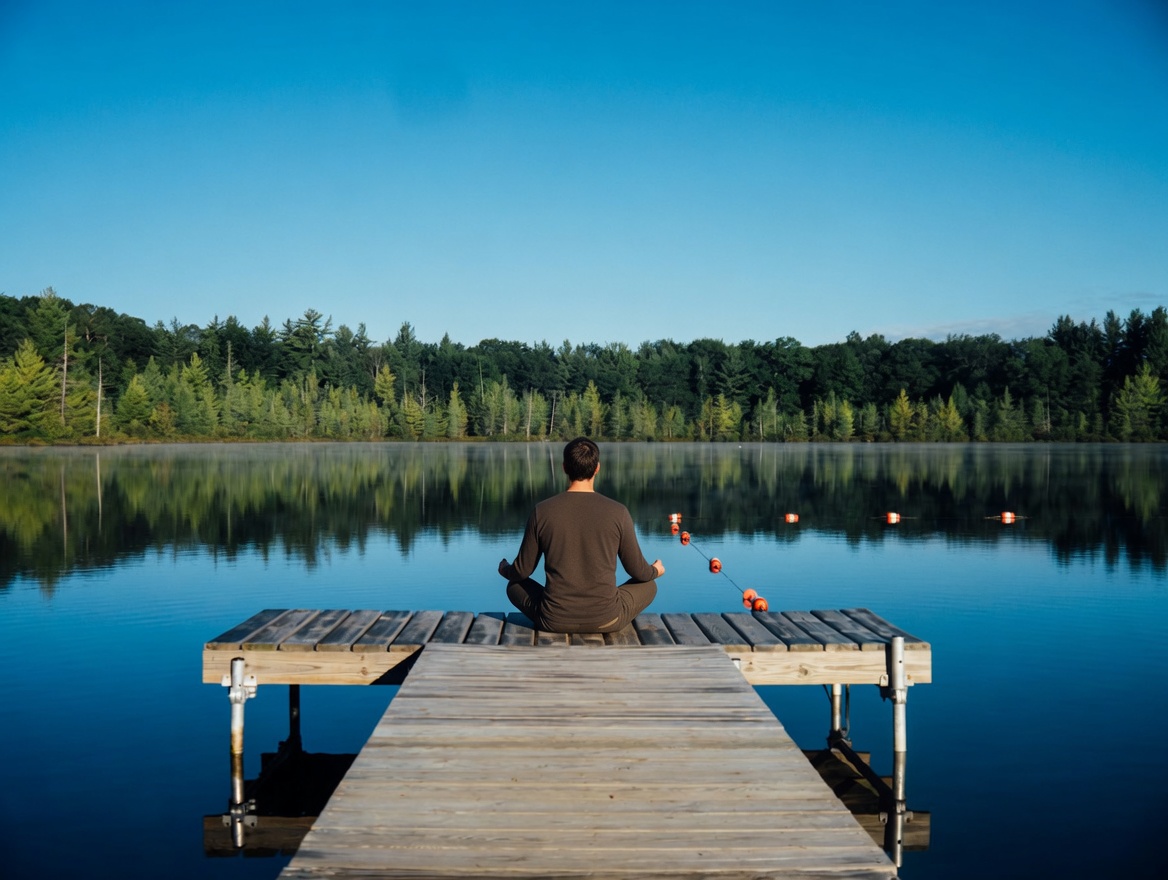
You decide on Sunday night that you are going to change something. By Wednesday you have not started, and nobody has noticed, including you. Nothing in an ordinary week forces the decision and the action back together, so the gap stays open. The higher self is the part of you that closes it with no one watching. That can be trained, and this domain trains it from three sides: intention, flow, and intuition.
Intention comes first, because the evidence is unusually clear. Across ninety-four studies38002-1) covering more than eight thousand people, those who decided in advance when and where they would act on a goal followed through at a much higher rate than those who set the goal and simply meant to. Wanting it more had nothing to do with it. The difference was in how the intention was written down, and that method is the first thing you learn here.
Once you can hold an intention, flow becomes available. Researchers agree on three conditions for it: a task slightly harder than your current skill, a goal clear enough to aim at, and feedback quick enough to adjust to. The middle one is an intention stated well, which is why the two are taught together. Flow also turns up somewhere most men do not expect. When people were interrupted at random through the day and asked what they were experiencing, nearly all of their flow states happened at work and almost none in their free time, and the same people still said they would rather have been at leisure.
Intuition is the third piece, and it is trained differently. It begins with sitting still, because a tense mind cannot pick up a faint signal, and once you can do that we bring in a professional remote viewer. For more than twenty years, ending in 1995, the CIA and the Army paid people to sit in a room and describe places they had never seen. The program was called Star Gate. The files were declassified that year and reviewed by outside scientists, and we teach from them, the hits and the misses both, and let you decide what you make of it.
Breathwork runs underneath all three. It is the fastest way we know to take a mind from braced to still, which is the state intuition needs and the state flow starts from. At about six breaths a minute the heart, the lungs, and blood pressure settle into one rhythm, and you can feel the change within a few minutes. It takes an afternoon to learn and years to get good at, and you will keep using it in Endurance.
What men tell us afterward is that their heads are quieter, they are slower to anger, and they have started keeping the promises they make to themselves.
Gollwitzer & Sheeran, Advances in Experimental Social Psychology (2006) · Csikszentmihalyi & LeFevre, Journal of Personality and Social Psychology (1989) · Fong et al., Journal of Positive Psychology (2015) · Lehrer & Gevirtz, Frontiers in Psychology (2014) · An Evaluation of Remote Viewing, American Institutes for Research (1995)